When you enter a tile store or browse a ceramic website you have hundreds of options.
Tile of Different finishes. Different sizes. Different prices.
People often get stuck with a big question in their mind
Porcelain or ceramic?
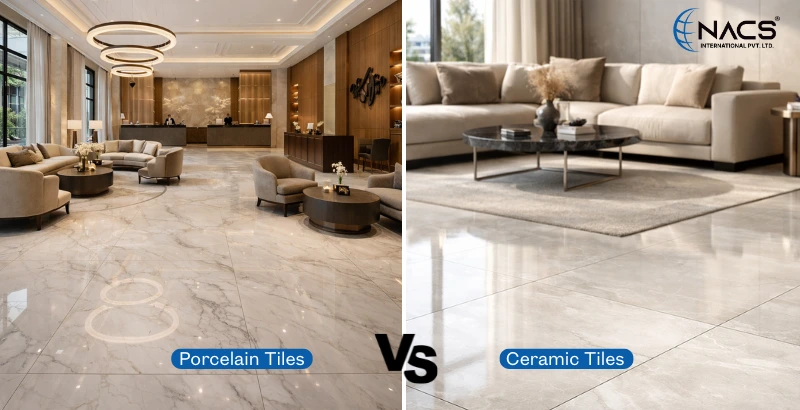
They are so identical that you can't directly state a difference by just looking at a catalogue or an image. The difference is hidden beneath the layers.
Which one is good for your project? Which one is more durable? What to choose and what not to? Continue reading this blog to get all the answers.
Porcelain Tiles vs Ceramic Tiles: How To State A Difference?
Follow the table to understand the key differences between porcelain tiles and ceramic tiles.
| Feature | Porcelain Tiles | Ceramic Tiles |
| Material Composition | Made from refined clay and minerals | Made from natural clay |
| Firing Temperature | Fired at very high temperatures | Fired at lower temperatures |
| Density | Very dense and compact | Less dense |
| Water Absorption | Extremely low (below 0.5%) | Higher water absorption |
| Durability | Very strong and long-lasting | Good but less durable |
| Best Use Areas | Floors, high-traffic areas, outdoor spaces | Walls, low-traffic floors |
| Maintenance | Easy to clean and maintain | Easy to maintain |
| Installation | Harder to cut due to density | Easier to cut and install |
| Cost | Usually higher | Usually more economical |
This table explains why porcelain tiles are often chosen for areas that demand stronger performance.
How To Identify Porcelain Tiles
Porcelain tiles come under a category of ceramic tiles but they are more tougher and durable. The major difference lies in the surface itself.
Porcelain tiles are non-porous and impervious in nature. These are more thicker tiles with nearly zero water absorption. Thus, these tiles are used in high traffic areas.
How To Identify Ceramic Tiles?
You can't make a difference by visual glance. Ceramic tiles are similar looking to porcelain tiles as they are made from the same materials as clay and minerals.
But these tiles are thin and less durable as they are porous in nature. Thus the major use cases are seen in low traffic spaces.
Which Tile Is Better for Flooring?
Let’s think practically.
Floors deal with constant pressure. Walking. Furniture. Movement.
So durability becomes important.
Porcelain tiles handle this extremely well because of their dense composition.
They are ideal for:
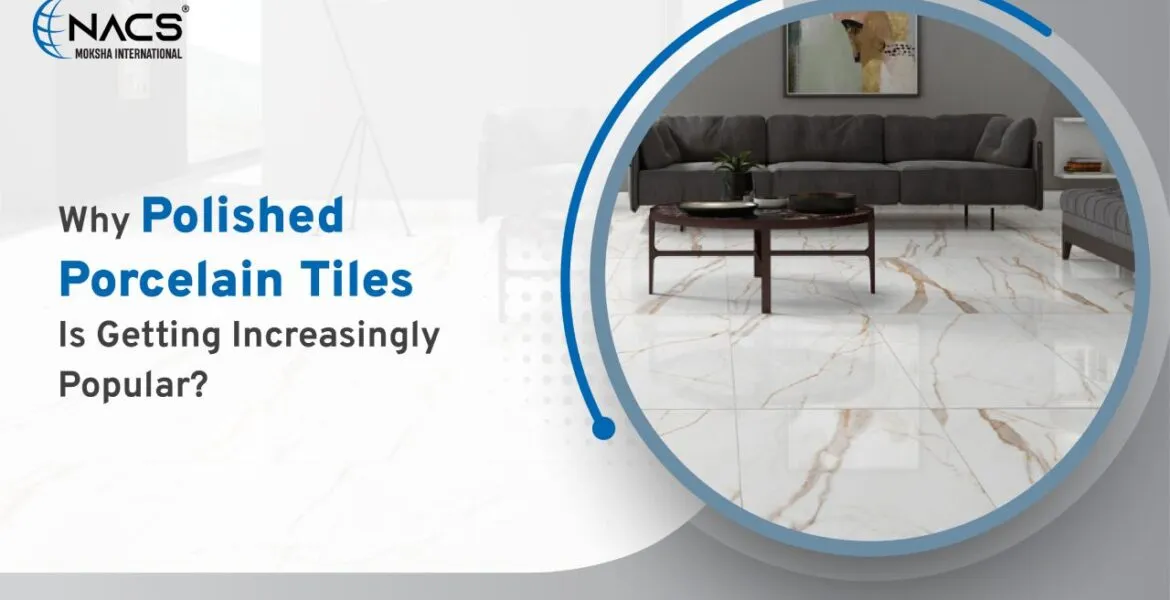
- Living rooms
- Hallways
- Kitchens
- Commercial floors
Ceramic tiles can be used for low traffic areas such as balconies or bedrooms. For commercial spaces, if you are going with ceramics, they you have to choose large and thick size formats that may raise cost concerns.
What Works Better in Bathrooms?
The answer is pretty simple. Porcelain tiles. Porcelain tiles have a nearly negligible water absorption rate. That makes them a cleaner and safer choice for bathroom floors and walls.
Porcelain tiles in the bathroom are easier to clean and maintain. Their moisture resistance makes them look new even after years of usage.
On the other hand ceramics can look dull and patchy even after months of use due to high water absorption.
Thinking About Outdoor Spaces?
Planning a balcony makeover? A garden patio? Maybe a rooftop seating area?
Outdoor environments are tougher on materials.
Tiles here must handle:
- Rain
- Sun exposure
- Temperature changes
Porcelain tiles are much better suited for these conditions because of their low porosity.
They are widely used in:
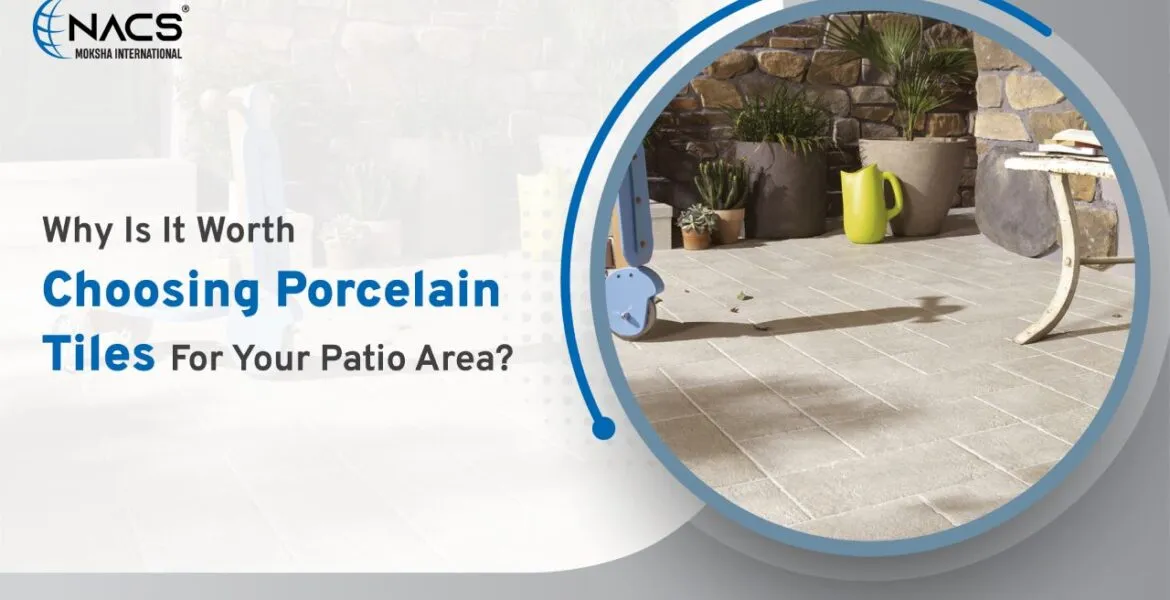
- Outdoor patios
- Balconies
- Garden walkways
- Poolside areas
Ceramic tiles are generally not recommended outdoors in climates with strong weather changes.
What About Maintenance?
Here’s some good news.
Both tile types are relatively easy to maintain.
A simple routine usually works:
- Regular sweeping
- Occasional mopping
- Mild cleaning solutions
Porcelain tiles, however, tend to hold up better in the long run because of their dense structure.
They are more resistant to:
- Chips
- Surface scratches
- Heavy impact
So… Which One Should You Choose?
Still unsure?
Think about how the space will be used.
Ceramic tiles are a great choice if:
- You want decorative walls
- The area has light foot traffic
- You want easier installation
- Budget is a major factor
Porcelain tiles work better if:
- The area experiences heavy use
- Moisture resistance is important
- The tiles will be used outdoors
- Durability is the top priority
Why Importers Choose NACS International?
Choosing the right tiles is important but choosing the right manufacturer becomes even more important when you want quality and trust. NACS International is India’s one of the largest porcelain tiles manufacturer and exporter with more than 15 years of experience. Crafting quality porcelain tiles is our expertise and making it available for all at the right prices is our moto. But why should you choose us? Let’s understand:
- Our tiles are certified by ISO and commit to stand on international grades.
- Crafted with advanced manufacturing technology, our tiles are highly durable and strong
- We provide a wide range of size formats starting from 600x600 porcelain tiles to 800x3000 porcelain tiles
- Global export facility to more than 20 countries
- Competitive pricing on bulk orders
Connect With Us Today
Transform your project into an iconic landmark with NACS International's expertly crafted porcelain tiles. Connect with us today to know more about design options and pricing.
Frequently Asked Questions
Porcelain tiles are denser and absorb less water than ceramic tiles. This makes them stronger and better for high-traffic areas.
Porcelain tiles are more durable and moisture resistant, making them suitable for floors, bathrooms, and outdoor areas.
Yes. Ceramic tiles are generally more economical and easier to install compared to porcelain tiles.